
Why Is My Business Not Showing Up in Local Google Searches?
So, you have a website. You have a Google Business Profile. You may even have a handful of great reviews. So why then, is your business not showing up on Google when potential customers search for the products or services you offer?
It is one of the most common frustrations we hear from small business owners.
You might search for your own business by name and find it immediately. But search for something a potential customer would actually type, such as “accountant near me,” “Morro Bay massage,” “Nipomo real estate agent,” or “moving company Monterey,” and suddenly your business is nowhere to be found.
That does not necessarily mean something is wrong with your website or Google Business Profile. Local search is much more competitive and location-dependent than many business owners realize.
Understanding how Google determines local results can help explain why your business appears in some searches, disappears in others, and what you can do to improve your local visibility.
Finding Your Business by Name Isn’t the Same as Ranking Locally
One of the first mistakes business owners make when checking their Google visibility is searching for their company name.
If someone searches specifically for Crackerjack Strategies, Google has a pretty good idea which business they’re trying to find.
But that is very different from someone in Arroyo Grande searching for:
“local SEO company near me”
Now Google has to decide which businesses are most relevant to that search and which ones should appear prominently.
The same applies to nearly every local business.
A winery might easily appear when someone searches its exact name but have difficulty appearing for “Templeton wineries.”
A real estate agent may rank for their own name but not “Nipomo homes for sale.”
A massage therapist may appear when an existing client searches for the business but struggles with “massage therapist Morro Bay.”
The searches that introduce your business to new customers are often the ones that matter most.
Google Local Results Can Change Depending on Where You Search
This is one of the biggest misconceptions about local SEO.
There isn’t necessarily one universal ranking for a local keyword.
Where the person conducting the search is physically located can significantly affect what Google shows them.
Google says that local results are primarily determined by three factors: relevance, distance and prominence.
That distance component is especially important.
Imagine a business located in Grover Beach that serves customers throughout the Five Cities area.
Someone searching from Grover Beach might see that business prominently. Someone conducting the exact same search from Pismo Beach could see it several positions lower. Move the searcher to Arroyo Grande or Oceano, and the results may change again.
That’s why simply sitting at your desk and Googling your own keywords doesn’t provide a complete picture of your local search performance.
Your business might be performing very well within two miles of your location while barely appearing five or ten miles away.
For businesses on the Central Coast, those distances matter. Communities such as Pismo Beach, Grover Beach, Arroyo Grande, Oceano and Nipomo are close geographically, but Google still evaluates the location of the person searching when determining local results.
What Is the Google Map Pack?
For many local searches, Google displays a group of businesses alongside a map near the top of the search results. This is commonly called the Google Map Pack or Local Pack.
Appearing prominently here can be extremely valuable because customers can quickly see information such as your business name, reviews, hours, location and other details without having to scroll through traditional website results first.
The important thing to understand is that your website’s organic ranking and your Map Pack visibility are related, but they aren’t exactly the same thing.
A business can have a strong website and still struggle in Maps.
Likewise, a business might perform reasonably well in the Map Pack close to its physical location but have limited visibility farther away.
Effective local SEO looks at the entire local search presence rather than concentrating on just one ranking.
Your Google Business Profile May Need Work
Having a Google Business Profile doesn’t automatically mean it is fully optimized.
Google recommends providing complete and accurate information to help it understand what a business does, where it is located and when customers can visit.
Your primary business category is particularly important because it helps define what type of business you operate.
Additional information can strengthen the profile and make it more useful to potential customers, including:
- Accurate business hours
- Appropriate secondary categories
- Services and products
- Business description
- Photos
- Service areas, where appropriate
- Contact information
- Website information
- Customer reviews
This information should also remain current.
Businesses change hours. Services evolve. Phone numbers change. Websites get redesigned. Locations move.
Local SEO isn’t something that should be configured once and then forgotten.
Your Business Information May Be Inconsistent Across the Internet
Google doesn’t rely exclusively on the information you enter into your Google Business Profile.
Information about businesses can come from multiple sources across the web.
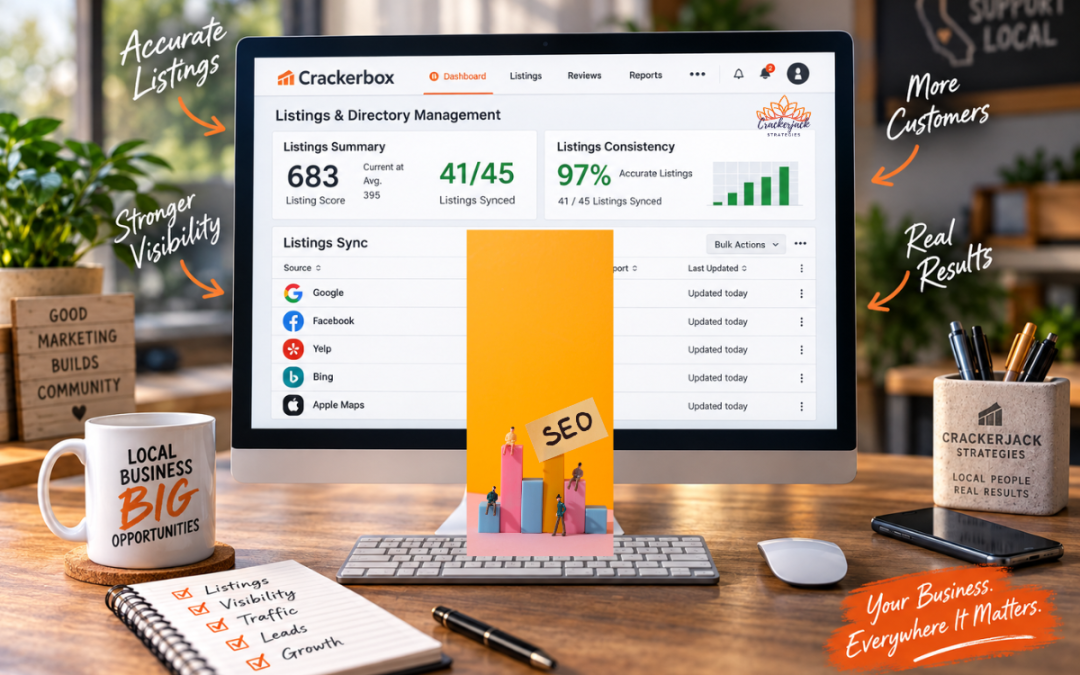
That’s one reason business listings and directories still matter for local SEO.
Your business may appear on platforms and directories such as Google, Bing, Apple Maps, Yelp, Facebook and many others.
Over the years, those listings can become messy.
Maybe an old phone number is still floating around. Perhaps your company moved five years ago and an old address remains listed somewhere. There may be duplicate listings or slightly different versions of the business name.
Individually, these problems might seem minor. Collectively, they can create an inconsistent digital footprint.
Listings management helps keep important business information accurate and consistent across the places customers and search engines encounter your company.
It also saves business owners from trying to manually find and maintain dozens of individual listings.
Your Website May Not Be Sending Strong Enough Local Signals
Your Google Business Profile is only part of your local presence.
Your website also helps search engines understand what you do and where you do it.
A beautiful website that barely mentions the communities you serve isn’t giving Google much local context.
For example, saying:
“We provide professional accounting services.”
Tells Google what the business does.
But content explaining that the company provides accounting and tax services to businesses and individuals throughout Arroyo Grande, Grover Beach, Pismo Beach, Nipomo and San Luis Obispo County provides much more context about its geographic relevance.
That doesn’t mean stuffing city names into every paragraph.
Good local website content should sound natural and be useful to actual customers.
Service pages, location information, locally relevant blog content, title tags, headings, internal links and structured business information can all help search engines better understand the relationship between your business, its services and its geographic market.
Your Competitors May Simply Be Doing More
Sometimes there isn’t a glaring technical problem.
Your competition may simply have a stronger local presence.
Consider two businesses offering essentially the same service.
One has a complete Google Business Profile, regularly receives customer reviews, maintains accurate business listings, has a well-optimized website, publishes useful local content and has earned links and mentions from other websites.
The other has a website and a Google Business Profile that hasn’t been touched in two years.
Google has considerably more information available to evaluate the first business.
This is especially noticeable in competitive Central Coast markets.
A business trying to reach customers throughout San Luis Obispo may be competing against dozens of companies for valuable local searches. The same is true for real estate in the Five Cities, wineries around Paso Robles and Templeton, hospitality businesses near Pismo Beach, or home services throughout San Luis Obispo County.
Simply being local isn’t enough to guarantee local visibility.
Reviews Matter, But There Is More to Local SEO Than Reviews
Reviews are an important component of your local presence.
They provide prospective customers with valuable information about previous customers’ experiences and help establish trust before someone ever calls or visits your website.
Google also identifies review quantity and positive ratings as factors that can contribute to local prominence.
But reviews aren’t a magic button.
A business with 100 reviews won’t automatically outrank a business with 50.
Local search considers multiple signals together, including relevance, distance and prominence. Your Google Business Profile, website, business listings, reviews and broader online presence all contribute to that picture.
The goal should be to build a healthy local presence rather than obsessing over one metric.
Stop Checking Your Rankings From Just One Location
This is where local search rank tracking becomes extremely useful.
Instead of asking:
“What position do I rank for this keyword?”
a better question is:
“Where do I rank for this keyword throughout the area I actually serve?”
Geo-grid tracking allows us to evaluate a keyword from multiple geographic points surrounding a business.
The result is essentially a map of local search visibility.
You may discover that you’re ranking in the top three positions close to your business but dropping considerably farther away.
Or you might find a particular community where your visibility is surprisingly weak despite regularly serving customers there.
That information gives local SEO strategy some direction.
Rather than guessing, you can identify where visibility is strong, where it falls off and how that changes over time.
Local SEO Isn’t About Ranking #1 Everywhere
This is another expectation worth addressing.
No reputable company can simply guarantee that your business will be #1 throughout an entire city or region.
Google itself states that there is no way to request or pay for a better local ranking.
Distance alone makes universal rankings unrealistic.
A plumber based in Arroyo Grande shouldn’t necessarily expect to outrank a plumber located around the corner from a searcher in northern San Luis Obispo every time someone searches “plumber near me.”
That doesn’t mean local SEO isn’t working.
The objective is to strengthen your overall visibility for the searches, services and geographic areas that matter to your business.
Over time, that can mean appearing for more relevant searches, improving visibility across a larger portion of your service area and turning that visibility into website visits, phone calls and leads.
Local SEO Should Produce More Than a Ranking Report
Rankings are useful, but they’re only one piece of the puzzle.
Ultimately, businesses aren’t investing in local SEO because they want a pretty ranking chart.
They want customers.
That’s why we prefer looking at a broader set of performance indicators, including:
- Local keyword visibility
- Map Pack performance
- Google Business Profile impressions and engagement
- Website traffic
- Phone calls
- Website clicks
- Leads and conversions
These measurements provide a much better picture of whether your local presence is actually improving.
A keyword moving from position eight to position four is encouraging.
But if improved visibility also results in more people finding your business, visiting your website and contacting you, that’s much more meaningful.
So, Why Is Your Business Not Showing Up on Google?
Usually, there isn’t one simple answer.
It may be your Google Business Profile.
It may be your website.
It may be inconsistent business listings.
It may be a lack of reviews or local authority.
It could be stronger competitors.
And sometimes your business is showing up, just not from the particular location where you’re checking.
That’s why a good local SEO strategy starts by establishing where you actually stand.
At Crackerjack Strategies, we look beyond a single Google search from a single computer. Our Local SEO Services are designed to help businesses build a stronger and more consistent local search presence through business listings management, local keyword tracking, Map Pack visibility monitoring, Google Business Profile optimization and ongoing performance reporting.
We’re also a local Central Coast business ourselves. We understand that reaching customers in Grover Beach can be different from reaching customers in Arroyo Grande, Pismo Beach, Nipomo or San Luis Obispo, even though those communities may only be a few miles apart.
Ready to See Where Your Business Actually Stands?
If you’ve been wondering why your business is not showing up on Google, don’t rely on repeatedly searching for yourself and hoping the results change.
Find out where your business is visible, where it isn’t, and where there may be opportunities to improve.